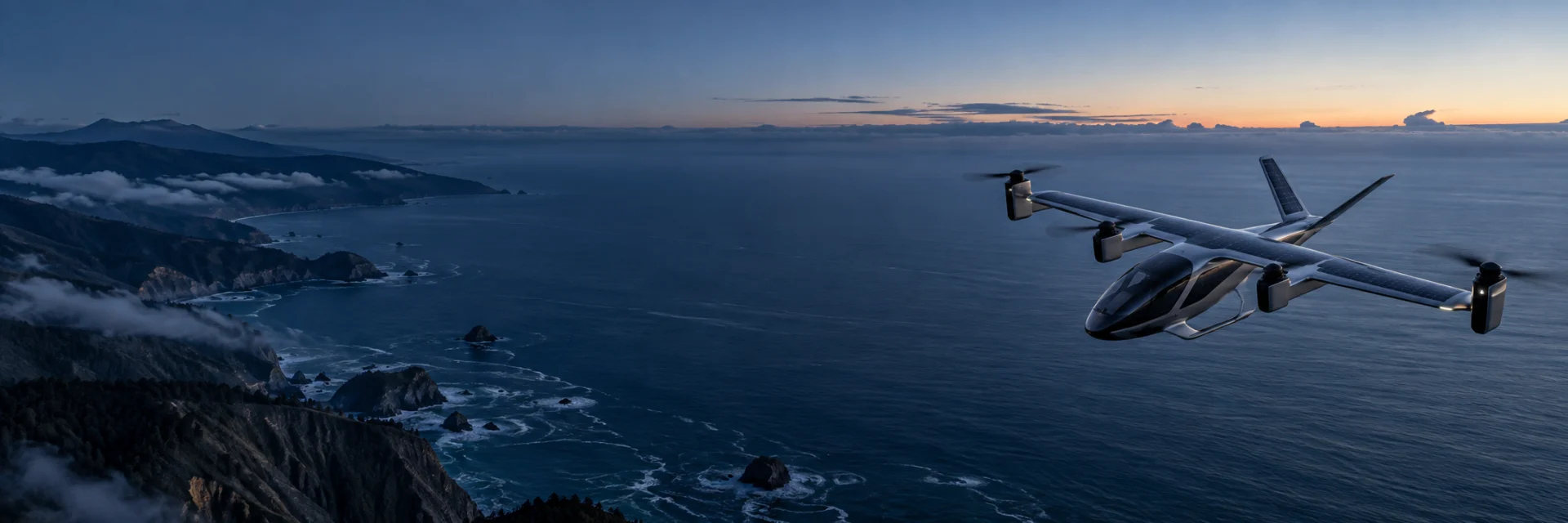
Solar-Powered UAVs & eVTOL
Long-endurance aviation
Extend useful flight time without ignoring airframe constraints.
Solar-assisted UAV and eVTOL concepts connect photovoltaic generation with wing area, mass, propulsion demand and mission profile.
HyperCirra supports early application development and lightweight surface concepts. Airworthiness, structural performance and flight endurance require platform-specific analysis and formal validation.
Research, integration and flight-validation pathway

Design priorities
Built around endurance, mass and aerodynamic fit.
Aviation value comes from the complete energy and airframe trade, not laboratory efficiency in isolation.
Specific-power focus
Balance generation, encapsulation and interconnect mass against the aircraft energy budget.
Aerodynamic conformity
Adapt solar surfaces to wing geometry while protecting airflow and structural behavior.
Mission-led modeling
Estimate benefit across altitude, latitude, season, flight profile and propulsion demand.
Application pathway
From mission model to representative flight testing.
Concept work should connect photovoltaic assumptions to airframe interfaces and a staged verification plan.
- 01
Define mission duration, route, altitude and power demand.
- 02
Map usable wing and body surfaces with shading constraints.
- 03
Develop lightweight module, laminate and interconnect concepts.
- 04
Coordinate MPPT, storage and aircraft electrical interfaces.
- 05
Validate through coupons, ground tests and representative flight stages.
Project readiness
Bring the mission profile into the first review.
Flight duration alone is not enough; the operating envelope determines the value and risk of solar assistance.
Discuss an aviation energy concept →- Aircraft type, mission profile and target endurance.
- Available wing area, curvature and structural limits.
- Mass budget and center-of-gravity constraints.
- Bus voltage, propulsion load and storage architecture.
- Environmental, airworthiness and flight-test requirements.